Skin is the most demanding test in figurative painting. A mistake in a piece of fabric or on a wall goes unnoticed. A mistake in a face is spotted at once, even if the viewer can't say why: we have spent our whole lives reading faces, and that reading is unforgiving.
The difficulty begins with a wrong idea, that skin has a color. Anyone who looks for it on the palette ends up with a uniform pink mixture that looks like plastic. Skin is a translucent material. Light enters, passes through layers of different thickness, meets blood, fat and bone, and comes out transformed. What we see is the sum of all that, and it changes with every centimeter.
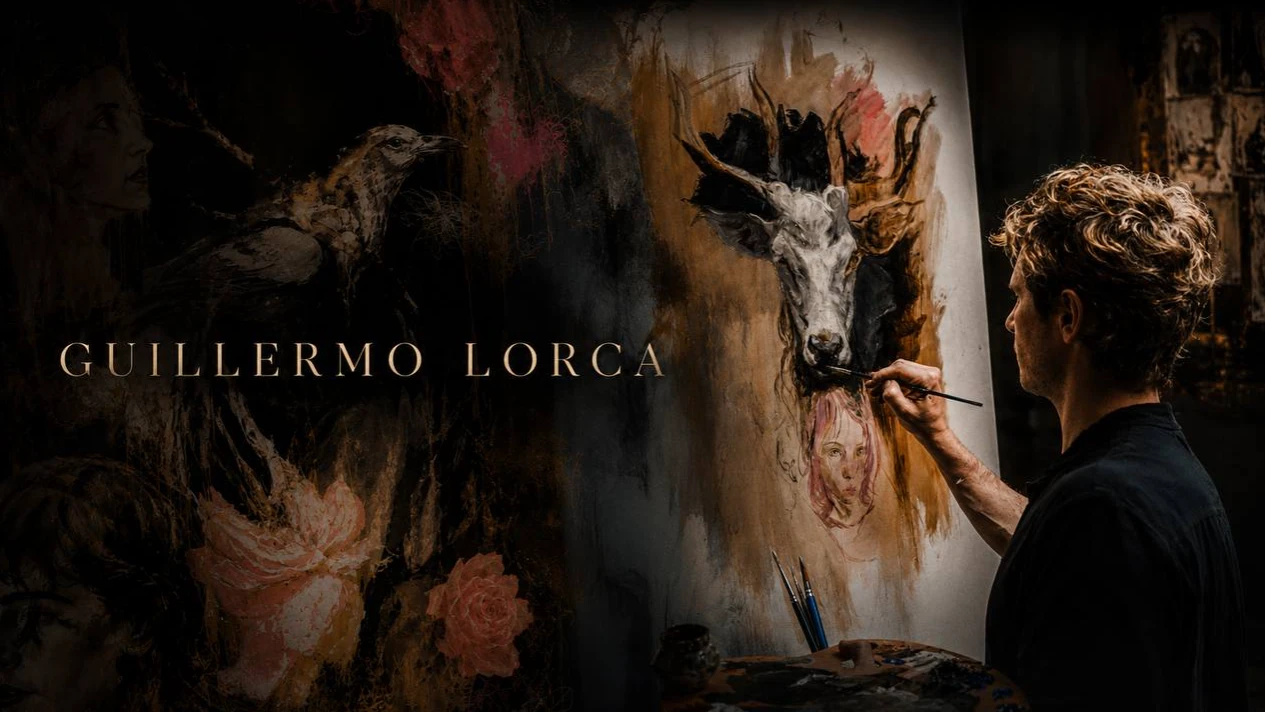
Three decisions account for much of what makes painted skin look alive: how grays are used, how transitions are resolved and where the points of light are placed. These are the three questions that Guillermo Lorca's masterclass addresses for painting skin, hair and white animals.
Grays make the color
The first impulse is to warm things up. You add red, you add ocher, and the mixture saturates until it loses credibility. Figurative painting tends to go the other way: a warm tone looks warm because there is a neutral tone next to it.
In the 19th century, the French chemist Michel Eugène Chevreul described this effect as simultaneous contrast: a color changes according to what surrounds it. Applied to skin, it means that a gray placed next to a discreet pink makes that pink look brighter than it is. The palette doesn't need more color. It needs better neighbors.
That is why skin holds more grays than it seems to. Where the bone sits close to the surface, as on the forehead, it tends toward yellow. On the cheeks, nose and ears, with more blood flow, it moves toward red. Around the mouth and along the jaw, cooler tones appear, which in many faces verge on green or blue. None of them is obvious on its own. Together, and muted with just the right amount of gray, they build a surface that seems to have blood beneath it.
The idea is an old one. Around the year 1400, Cennino Cennini's treatise explained how to prepare flesh tones over a base of green earth, which went on working beneath the pink layers. Cool under warm gave depth then and still does today.
There is an order that helps: first choose the value, that is, how light or dark a tone is, and then its temperature. If the value is right, the form works even if the color isn't exact. The reverse almost never happens.
Transitions build volume
A face has no lines. It has planes that turn. Every form moves from light to shadow through a band of halftones, and that band decides whether there is volume or just color.
Three things are worth watching:
- The width of the step. A round form, like the cheek, turns slowly and calls for a long transition. An angular form, like the bridge of the nose, turns quickly and calls for a short one.
- Saturation. Color is usually most intense in the halftones, just before entering the shadow, and not in the brightest area. That is where skin reddens most believably.
- Edges. Not all of them should be equally sharp. A lost edge between the jaw and the neck adds air and guides the eye toward what is defined.
The usual mistake is over-blending. Smoothing the entire surface with the brush gives a porcelain finish, correct and lifeless. Skin has pores, fine hair, veins and small irregularities. A well-painted transition is usually made of brushstrokes that are visible up close and merge at viewing distance.
The order of the layers matters here. Lorca's masterclass works with a combination of oil and acrylic: quick first layers, glazes and final touches rich in paint. Glazes are thin, transparent layers applied over a layer that has already dried. Light passes through them, bounces off what lies beneath and comes back out, so the color forms inside the paint and not only on top of it. It is the behavior closest to that of skin itself.
Points of light are earned
A highlight placed at the right moment makes a surface look moist and alive. Placed too early, or scattered all over the face, it turns that surface into wax.
The point of light is the direct reflection of the light source on the oil and moisture of the skin. That is why it appears in specific places: the tip of the nose, the lower lip, the eyelid, the curve of the forehead, the knuckles. Its shape follows the plane that receives it, and its color comes close to that of the light producing it. It is rarely pure white, even if it looks that way by contrast.
Three criteria help with the decision:
- Fewer than you can see. A face offers many highlights. A painting needs only a few, with one main highlight and the others subordinate to it.
- Last. The point of light is the final decision. It goes on a form that is already resolved, and it doesn't fix a weak form.
- With body. Oil painting has a long tradition of reserving thick paint for the lights and keeping the shadows thin. That difference in texture makes light seem to come off the surface, and Rembrandt pushed it very far in portraiture.
The same goes for hair and white fur. A white animal painted with white stays flat. White is built with grays, and the point of light only works because everything else sits below it.
A craft of decisions
Painting skin is, above all, a matter of deciding what not to paint. Nobody copies every pore. You choose the grays that support the color, the width of each step and the few places where light gets to shine. That selection explains why two painters in front of the same model produce two different faces, and why both look alive.
These are decisions better understood by watching them being made than by reading about them. In this masterclass on figurative painting and magical realism, Guillermo Lorca shows the thinking, planning and construction behind the paintings. Technique can be explained in an article. Judgment is formed by looking.